|
| photo credit: Sahil Bajaj |
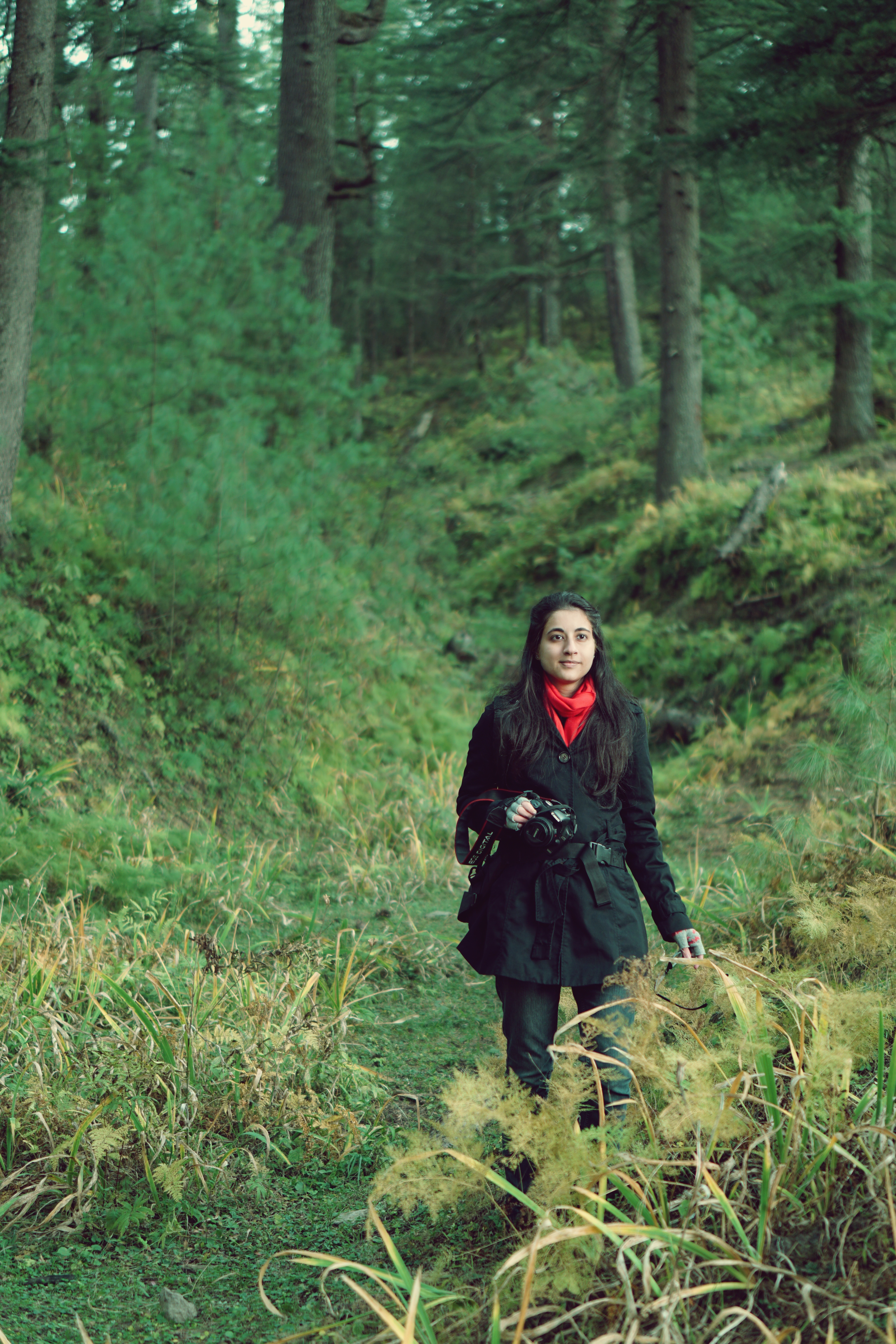
I'm a mountain person. I was three years old when I first visited my grandparents' secluded home in the Himalayas. Though I was too young to realise it at the time, the sense of possibility that this new world opened up would stay with me.
 |
| Himachal Pradesh, 2016, photo credit: Sahil Bajaj |
Kriti, this is how you begin to describe yourself on your website: I've lived in cities my entire life – Bombay, Delhi, London – but every so often, I have a longing for grass studded with clover, starry skies and a majestic view that changes with each cloud and shadow, but is always constant. I mean, is it any wonder we ‘found’ each other? Poets just do! 'Poet’ may not be a term you would use to describe yourself, but I mean it in the way a writer uses her language. So, there you are, three years old in the Himalayas… were there books there? Did you start writing as a child?
There's a whole wall of books, though I can't remember whether this excited me at that age – I was a bit of a late bloomer when it came to reading. It's one of my favourite nooks in my grandparents' home. There was no internet here until a few years ago, and even phones arrived relatively recently. As a child, I used to communicate with my grandparents through letters. Many of the books are encyclopedias and reference texts on everything imaginable; my grandfather had many interests, from carpentry to photography. He once bought the contents of an entire bookshop!
 |
| photo credit: Kriti Bajaj |
I used to write poetry before I ever wrote anything else. I remember the first 'serious' poem I wrote was in fifth grade, and it was probably very derivative – I mean, I was only ten – but it felt like I'd found my calling. I'd come across little snippets of poetry at my grandparents' home, newspaper cuttings of poems by Patience Strong that my great-grandmother used to send to my grandmother, which I found wonderfully simple and musical. My nana also loved poetry and would recite some of his favourites often – Omar Khayyam, Swinburne, Henley – and inevitably start crying a few lines in. I wrote poetry all through my school and college years, with rhymes gradually giving way to free verse, and imaginative themes being replaced by real experiences.
There were a few years between the first time I met Clive James and the second. It was during our second encounter that he told me about a young friend he had made on the oncology ward (he and I met on a less specific infusion ward), only to lose her to a rare bone cancer. This friend happened also to be your dear friend, Shikha. Tell us a little about 'Oblomov'?
I met Shikha (known to the world as Oblomov) in my final year of college, when we were editors at a Model United Nations conference, leading a team together, completing each other's sentences and finding that it was very peaceful to curl up in our cabin rather than attend the sessions. We did our Masters in London at the same time too. The best introduction to Shikha is through her own words, so I will direct readers to her beautiful blog. So many amazing people found Shikha through this, and she connected kindred spirits, like you and I.
 |
| Kensington Gardens, Oct 2011, credit: Kriti Bajaj |
Clive James, of course, made her very happy through his enthusiastic support of her writing, and his wonderful sense of humour, some of which she shared with me. I reached out to him once in April 2015 with sad news, and we exchanged a few notes. He was very gracious; his words brought comfort.
Since 2016, you have been on an ancestral quest to discover more about your family tree. Tell us a little about that? I often find myself googling my grandfather who was the first Muslim Chief Justice of Udaipur and aide-de-camp to the Sultan of Zanzibar. I want him to just pop up! I do the same for my great-grandfather, who was another High Court Judge, from my maternal Parsi side. Both were Khan Bahadurs. My maternal grandfather was in the railways like your great grandfathers. Trying to trace the female line is much harder, unless you have someone doing the oral remembering, like my mother. I am so envious of your ability to access from direct sources and digitise your findings - future generations will no doubt be thankful to you!
That's literally how I took a step forward with my research – I Googled my great-grandfather and he popped up! I'd done this for years, but there was nothing. I'd heard stories, seen photos, made family trees, but I was desperate for more. Then I went on a trip with my grandmother to her parents' last home, my first time there, and I felt really close to them even though I'd never known them. When I returned, information was awaiting me. I think the universe was sort of collaborating with me by giving me what I sought right after this trip.
 |
| photo credit: Kriti Bajaj |
An entire family tree appeared, going back generations. It made me realise that there were ways I could do this research myself. I didn't actually end up using much of the information since I wanted to verify everything on my own, but it was a start. Since then, I've been learning about genealogy through online courses, resources, Facebook groups, and I recently attended my first genealogy conference too. Of course, as you say, the availability of records has made it much easier to trace the lines and connect with more people, places, and contexts. I'm about to embark on research of another branch of my family, for which there will be far less information (and perhaps a lot lost during Partition), but interestingly, we do have access to a handwritten family tree in Urdu that might give us something to work with!
You went to Lady Shri Ram College. Tell us more about this experience - what is the college’s history? Why were/are you drawn to German particularly? Was it for German film appreciation?
LSR is a women’s college affiliated with the University of Delhi, though the campus is separate from the other colleges of the university and feels a bit like its own little world. It was founded in 1956 to encourage and enable the higher education of women. My years here were definitely a turning point, because up until then, I'd been more interested in studying the sciences than the arts. But literature was the perfect subject and opened my mind in many ways. I think both the colleges I've attended – LSR and SOAS in London – have shaped and added nuance to the way I view the world and what's happening in it.
 |
| Lady Shri Ram College, Delhi, credit: Kriti Bajaj |
I started learning German as a third language in school when I was ten. We had three options: German, French and Sanskrit. I felt drawn to German mostly because it was the underdog and we were tempted with promises of exchange programmes to Germany (which never materialised). I also attended weekend German classes at the Goethe Institut for about three years when I was in college. I enjoy the worlds and cultures that a new language allows access to, and I've tried learning several over the years, but so far, German is the one that stuck.
How did your interest in Zoroastrian heritage develop? I love that you were able to source a seven month internship at Parzor. (I’ve written for Hamazor.) Give us a sense of that time?
I wasn't very familiar with Zoroastrianism until I did the internship. Dr. Shernaz Cama was my professor at LSR and is also the Director of Parzor, and I'd expressed an interest in working there. I was taking a gap year after completing my Bachelor's degree as I figured out what to do with my life next, and I wanted to try all kinds of work. I also wanted to save money to buy my first camera, so a paid internship helped me meet both goals! I did all kinds of work during this time, from helping redesign brochures and the website, to assisting with sales, exhibitions and photography, as well as compiling Parzor's tenth anniversary souvenir book and covering the occasion for leading Parsi magazines like Hamazor, Parsiana and Fezana. This was the beginning of my freelance writing journey.


How extraordinary that you wrote a dissertation on mental health in film years before Deepika Padukone became the first Bollywood actress to openly speak about her mental health. What drew you to this topic?
I was studying anthropology at SOAS, and my interest was specifically in visual and media anthropology. But I had a hard time selecting a dissertation topic. In initial sessions with my supervisor, I presented my plan of writing about the role of photography in war, but somehow it didn't feel like the right fit then. (I do love photography and I'm researching its history independently now.) I thought about other topics that made me really eager to know more, because a dissertation is a fairly long road. I'd written one of my term papers on the complex relationship between anthropology and psychology – it was one of the topics we studied – and I'd been fascinated by it. So I decided to combine that with visual culture. I did find a fair amount of research on the portrayal of mental health in Hollywood films, but only one book about Bollywood. I thought this would be a good gap to fill.
 |
| 'East of the Sun and West of the Moon', Nielsen, 1914 |
Back to Bollywood, or rather not, how did your passion for line dancing come about? Why line dancing rather than … well, anything else? You’d fit right into any English or American dance class with that up your sleeve, but what’s the appeal? (I’m an ex Bharatnatyam and tap dancer, but ballet was definitely my true love. Now I just free style in the house, after hours, when no one’s looking…)
I didn't know what line dancing was until I showed up one day for a trial class by Merry Feet, which is one of the only line dance clubs in India. I'd been looking for a way to be physically active and I'm not really fond of going to the gym, so I thought dancing might be a fun way to care for both my physical and mental health. From the beginning, I loved the music, the way that line dancing brought together so many different dance traditions from around the world, the stories behind them, the philosophy of not chasing perfection but learning and repeating patterns, the inclusiveness. I also liked how it was a community or social dance form, but individualistic at the same time – both in that you don't need a partner (I've also learnt salsa and bachata for a while, and felt quite limited by that, though they are beautiful in their own way), and you have the freedom to express yourself within the structure of the choreography. Because of this, we were also able to learn and practice line dancing online throughout the lockdowns in the last two years.
 |
| 'In Powder and Crinoline', Nielsen, 1913 |
I also taught line dancing for a while before moving to Bombay. One of my happiest accomplishments – and this is what I love about teaching, mentoring and also learning – was watching the steady rise of confidence as people went from being very hesitant in the beginning to guiding new learners a few months in without a second thought!
 |
| 'Untitled', K K Hebbar, 1911-1996 |
About your many years as editorial manager for an art auction house, you say this: the real perk is getting to lay eyes on masterpieces that otherwise remain hidden away in private collections, as well as stunning gemstones, and centuries-old books and photographs. Tell us about one masterpiece in particular (or a few that spoke to you).
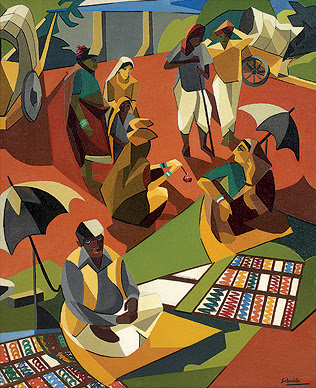
One of the first auctions I witnessed after joining Saffronart featured a beautiful painting by Nicholas Roerich. I'd been to his former home in Naggar a few years prior, and there are paintings there, but this one was quite different, almost haunting. Another artist whose work I really like is Jehangir Sabavala. Apart from art, I was fascinated by 19th century photographic processes like ambrotypes and stereoscopes, as well as rare and limited edition books such as those with illustrations by Kay Nielsen and Arthur Rackham.
 |
| 'The Dance in Cupid's Alley', Rackham, 1904 |
The colleague who sat nearest to me was in the jewellery department and would routinely receive boxes of glittering creations that were hard to look away from. I've never really been into jewellery but I do like beautiful things, and I've learned everything I now know about gemstones and techniques (which is probably just scratching the surface) from her. She even guided me when I was picking out my engagement/wedding ring!
 |
| 'The Bangle Sellers', Sabavala, 1954 |
Your 2021 calendar or cookbook of food inspired directly from books is so worth reading. Of all your many worthy accomplishments, I would recommend this as the most delightful and delicious. Which brings me to my final question - as a fellow blogger and non-fiction writer who secretly longs only to write fiction (but seems never to do so), do you fantasise about writing a novel? I ask this because I can easily imagine your novel - it will weave in the art world, and the food world, it will possess the photographer’s eye for detail and the researcher’s eye for historical/ genealogical accuracy. Am I way off course here? And if so, what dreams do you dream of next?
I think everyone who enjoys writing hopes to write a novel some day! When I was young and innocent, I attempted starting a couple – a fun exercise while it lasted, planning the stories, chapters, characters and so on. But I haven't attempted anything of the sort in a long time. The closest I've come is writing several dozen pages about my family history, a compilation of my research. I've always thought I'd write a book someday, when the right story comes along, so for now, I'm just waiting patiently. I used to think it would be fiction, because that's what I chiefly read, but I'm not so sure anymore. I've read some delightful non-fiction, and I wouldn't be averse to it if the story intrigued me. I have some latent ideas, though none are quite developed yet.
This year, I want to build my business further, continue my research, put time and resources into honing existing skills, and hopefully learn a few new ones. I also hope I'll get a chance to travel a bit and have a few little adventures here and there.
 |
| from Kriti's blog 'Onwards' |
Kriti, Clive’s sign off on all his emails to me was ‘Onwards’, the title of your blog, which was born months before you ever interacted with him. As you say, there are connections in everything. You chose 'Onward' as the title for your blog as a reminder to keep moving, keep learning, keep trying. Even when you don't really know where you are going, you remember that journeys are important. I wish you all the success and adventures your writing fingers and creative heart desire. Thank you for opening a little window into your life for my readers!
Kriti can be found at her website www.kritibajaj.com
 |
| photo credit: Kriti Bajaj |